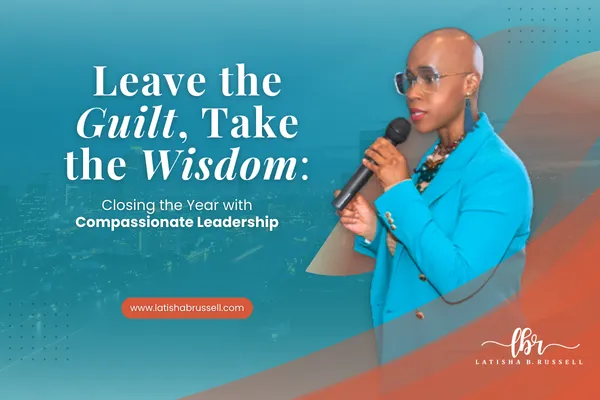
Leave the Guilt, Take the Wisdom: Closing the Year with Compassionate Leadership
Year-end has a way of turning even the most capable people into harsh critics.
Not because they are dramatic but because theyare carrying a lot and trying to make sure no one notices.
You review the wins, the misses, the relationships, the decisions you’d redo and suddenly you're holding more than a calendar year. You're holding guilt.
And if youare not careful, you'll bring that guilt straight into the new year where it quietly shapes your communication, your patience, your boundaries, and your ability to lead with steadiness.
This is your invitation to do something different:
Leave the guilt. Take wisdom.
Why we compartmentalize (and why it eventually leaks)
Many professionals are taught implicitly or explicitly to compartmentalize.
Keep personal life personal.
Keep work life productive.
Don’t be too emotional.
But compartmentalizing often isn't a strength.It's protection. It’s what people do when they believe their pain will be judged as weakness.
The problem is: what you don’t process doesn't disappear.
It shows up in your body.
It shows up in your tone.
It shows up in your relationships.
And it shows up in your leadership, even if you don't have the title.
Why leaders (and everyday professionals) carry guilt at the end of the year
Guilt shows up when you care and when youare holding yourself to a standard.
But many people don’t just feel guilt about outcomes. They feel guilt about moments:
A hard conversation they delayed
A team member they didn't support the way they wanted to
A boundary they didn't set
A season where personal stress leaked into professional tone
In my work with leaders and organizations, I support people who look successful on paper but are struggling behind the scenes.
Theyare not weak.
Theyare overloaded.
And they’ve been carrying more than they've admitted.
The hidden cost of guilt in the workplace
Guilt can feel like accountability, but it usually creates the opposite.
Instead of learning, people spiral. Instead of repairing, they avoid it. Instead of setting boundaries, they over-function.
Hereis what guilt tends to produce at work:
Reactive communication: short tone, sharp edges, less patience
Over-explaining: trying to manage perception instead of leading clearly
Decision fatigue: second-guessing and delayed action
Emotional leakage: stress showing up as control, withdrawal, or micromanagement
Guilt keeps you tied to the past. Wisdom prepares you for whatis next.
Compassionate leadership is not softits steady
Compassionate leadership is the ability to face reality without self-punishment.
Itis not ignoring impact.
Itis taking responsibility without turning it into shame.
Compassionate leadership sounds like:
That didn't go the way I wanted. Here’s what I'm learning.
I missed that. I'm addressing it.
I was under pressure and I didn't show up well. I'm repairing it.
That kind of leadership builds trust because itis honest.
And it builds psychological safety because it is regulated.
Leave the guilt: a year-end reflection for compassionate leadership
Before you write goals, do this reflection. Itis short, but itis powerful.
Step 1: Identify the moment you're still carrying
Ask yourself:
What moment from this year do I keep replaying?
Where do I feel regret, tension, or unfinished business?
Name it plainly.
No defending. No minimizing.
Step 2: Separate responsibility from shame
Responsibility sounds like:
I see what happened. I own my part. I'm going to respond.
Shame sounds like:
I'm a bad leader. I always mess things up. I'm not cut out for this.
One leads to growth.
The other leads to hiding.
Step 3: Extract the wisdom
Ask:
What pattern is this showing me about how I respond under pressure?
What skill would have helped me in that moment?
Common answers include:
Emotional regulation
Boundary-setting
Direct communication
Decision-making with incomplete information
Repair after conflict
Step 4: Choose one micro-practice for January
Wisdom becomes leadership when it becomes behavior.
Pick one small practice you can repeat weekly, such as:
Pause before responding in tense moments (10-second reset)
Start hard conversations with one clear sentence
Close meetings with Whats the decision, and who owns what?
Set one boundary and hold it consistently
Small reps create big shifts.
Close the year with compassion (and enter the new one with clarity)
Your team doesn't just experience your strategy.
They experience your emotional steadiness.
When you lead from guilt, you lead from tension.
When you lead from wisdom, you lead from clarity.
And clarity is a gift to everyone around you.
Take the wisdom into the new year
As you close the year, consider this:
What would change in your workand in your relationships if you stopped punishing yourself and started practicing what you've learned?
If youare ready to enter the new year with steadiness, I support leaders and organizations who want measurable behavior change, not just good intentions.
If you'd like to explore coaching, a leadership cohort, or a manager skills workshop for your team, reach out.
Leave the guilt. Take wisdom. And lead with compassion that strengthens performance.
Latisha B. Russell
Latisha B. Russell LLC provides Leadership Coaching, Wellness Coaching, and Professional Development services for individuals and organizations. Learn more about how we support real leaders at every stage at latishabrussell.com.


