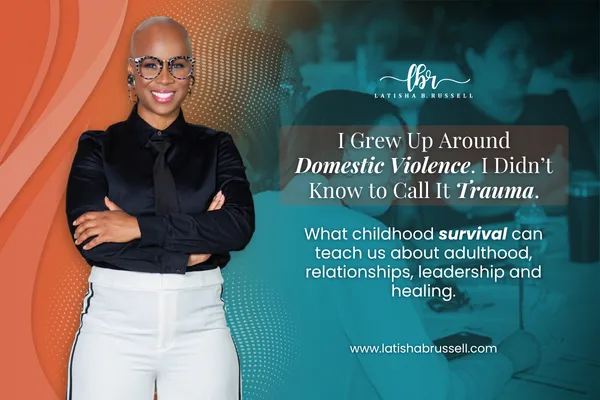
I Grew Up Around Domestic Violence. I Didn’t Know to Call It Trauma.
October is Domestic Violence Awareness Month and while you might expect the conversation to stay in clinical settings or community spaces, I want to bring them here, into a leadership conversation, because that is exactly where it belongs.
There are some things you do not fully understand until you are old enough to look back at them. October is Domestic Violence Awareness Month and in recognizing this, let's get real transparent because we as leaders and individuals spend too much time compartmentalizing things that might impact us.
Domestic violence is one of those things.
I grew up around domestic violence.
For a long time, I do not think I fully understood how much that experience impacted me.
Because when you grow up in certain environments, you learn how to keep going.
You learn how to compartmentalize.
You learn what gets discussed outside the house and what stays inside.
You learn how to read a room before you ever learn the phrase "emotional intelligence."
You learn when to be quiet.
You learn when something feels off.
You learn how to adjust yourself based on somebody else's mood.
And then you get up the next morning.
You go to school.
You smile.
You do what is expected of you.
You keep moving.
For many of us, that was called being strong.
As an adult, I have another word for some of it.
Trauma.
We Did Not Always Have Language for What Happened to Us
I think about how many people from my generation were taught to compartmentalize how we were raised.
You did not tell everybody your family's business.
You did not question adults.
You did not always talk about what happened behind closed doors.
You survived it.
Then you grew up.
The problem is, growing up does not automatically mean you have processed what you grew through.
You can leave the house where the violence happened and still carry the house with you.
That realization has been important for me.
Because witnessing violence in the home is not simply "seeing adults go through something."
It can be a traumatic childhood experience. The CDC identifies witnessing violence in the home as an adverse childhood experience, or ACE, and research has shown that adverse childhood experiences can affect health, relationships and well-being well into adulthood. SAMHSA also specifically recognizes domestic violence as a form of child trauma.
I did not have those words as a child.
I have them now.
And language matters.
You Can Be Successful and Still Be Carrying Something
This is one of the reasons I talk so much about emotional well-being today.
I know what it means to function.
I know what it means to perform.
I know what it means to keep going.
And I know that being able to function does not always mean you are unaffected.
Sometimes the very behaviors people praise in us were first developed because we needed them to survive.
For some people who grew up around instability or violence, that can look like becoming extremely independent.
Always being prepared.
Trying to anticipate what could go wrong.
Being highly aware of other people's emotions.
Avoiding conflict.
Trying to keep everyone happy.
Feeling responsible for fixing things.
Having difficulty asking for help.
Feeling uncomfortable when you are not in control.
Or becoming the person everybody else relies on because somewhere along the way you learned that relying on other people did not always feel safe.
Not every person responds to trauma the same way.
But I do believe we have to become curious about ourselves.
What did I learn to do because I needed to survive that I am still doing even though I am no longer in that environment?
That is a powerful question.
Survival Skills Can Follow Us into Leadership
This is where my personal story and my professional work often meet.
I work with leaders who are accomplished, respected and incredibly capable.
But leadership has a way of exposing what we have not addressed.
Conflict can trigger something.
Feeling dismissed can trigger something.
Someone raising their voice can trigger something.
Not feeling heard can trigger something.
Losing control of a situation can trigger something.
A leader may think, "Why am I reacting so strongly to this?"
Sometimes the present moment is touching something much older.
That does not mean we excuse harmful behavior.
It means we become responsible for understanding ourselves.
There is a difference between saying:
"This is just how I am."
and asking:
"Where did I learn this?"
That question changed a lot for me.
Domestic Violence Does Not Only Affect the Two People in the Relationship
This is something I want us to talk about more during Domestic Violence Awareness Month.
When violence happens inside a home, its impact can extend beyond the person being directly harmed.
Children see.
Children hear.
Children sense.
Children adjust.
Even when adults think they are protecting them from it.
And those children eventually become adults.
We become spouses.
Parents.
Leaders.
Friends.
Business owners.
Managers.
Caregivers.
We enter relationships carrying lessons we did not consciously choose.
That is why breaking cycles requires more than simply leaving a physical environment.
Sometimes the deeper work is recognizing what the environment taught you.
About love.
About anger.
About safety.
About communication.
About power.
About boundaries.
About what you believed you had to tolerate.
And perhaps most importantly, about what you believed was normal.
What Is Familiar Is Not Always Healthy
That sentence deserves to sit for a moment.
What is familiar is not always healthy.
When you have spent years around dysfunction, healthy relationships can initially feel unfamiliar.
Peace can feel strange.
Boundaries can feel uncomfortable.
Direct communication can feel confrontational.
Being able to disagree without fear can take some getting used to.
And being treated with consistency can feel almost suspicious when inconsistency was once normal.
Part of healing is learning that peace does not have to be earned by keeping everybody else happy.
Love does not require fear.
Disagreement does not have to become destruction.
You do not have to disappear inside a relationship to keep it together.
And children should not have to become experts at reading adults in order to feel safe.
We Also Have to Stop Asking, "Why Didn't They Just Leave?"
Domestic violence is complex.
Fear, financial dependence, children, housing, immigration concerns, isolation, threats, emotional manipulation and many other factors can make leaving dangerous and complicated.
The better question is not:
"Why didn't you leave?"
The better question is:
"How can I support you safely?"
Domestic violence affects millions of people. CDC data show that more than 1 in 3 women and more than 1 in 6 men in the United States have experienced contact sexual violence, physical violence and/or stalking by an intimate partner during their lifetimes.
These are not "other people's" families.
They are our families.
Our coworkers.
Our friends.
Our neighbors.
Our leaders.
And sometimes, they are us.
For the Person Who Grew Up Around It
I especially want to speak to the person who was not the partner in the relationship.
You were the child.
Maybe nobody ever asked you what it was like.
Maybe everyone was so focused on surviving the immediate situation that no one realized you were surviving it too.
Maybe you became "the strong one."
Maybe you became an achiever.
Maybe you learned very early how to take care of yourself.
Maybe you built a beautiful life.
And maybe there are still parts of that experience that show up in ways you are only beginning to recognize.
Your ability to survive it does not mean it did not affect you.
You are allowed to examine it.
You are allowed to name it.
You are allowed to talk about it.
You are allowed to decide that some of the things you learned in survival mode do not get to come with you into the next chapter of your life.
I am still learning that too.
Why I Am Sharing This
I do not share this because I want anyone to feel sorry for me.
Quite the opposite.
I share it because silence allows too many people to believe they are the only ones carrying these stories.
I share it because I know someone will read this and recognize themselves.
I share it because the little girl who learned to compartmentalize eventually became a woman who understands the importance of emotional well-being, boundaries, healthy communication and creating environments where people feel safe.
And I share it because Domestic Violence Awareness Month cannot only be about identifying bruises.
We have to talk about what violence leaves behind.
We have to talk about the children.
We have to talk about the adults those children become.
We have to talk about healing.
We have to talk about breaking cycles.
And we have to create enough safety that people do not have to spend decades pretending what happened to them did not matter.
What happened in our homes helped shape us.
But it does not have to have the final word on who we become.
If you are experiencing domestic violence or are concerned about someone you love, confidential support is available through the National Domestic Violence Hotline at 1-800-799-SAFE (7233). You can also text START to 88788 or connect with an advocate online.
Latisha B. Russell LLC provides Leadership Coaching, Wellness Coaching, and Professional Development services for individuals and organizations. Learn more about how we support real leaders at every stage at latishabrussell.com.


